digital tools and productivity
By Muhammad Qaisar
The Moment I Realized My Tools Were the Problem
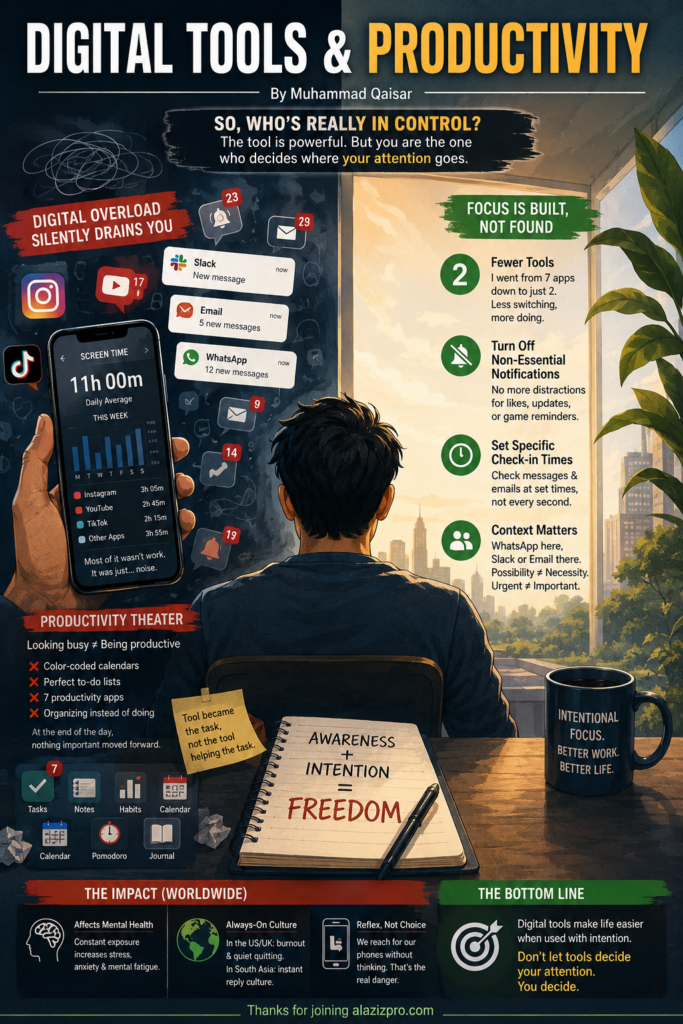
A friend of mine, Sumar, in Belgium, once showed me her phone’s screen time report and just started laughing, the kind of laugh that is not really about something funny. 11 hours. That was her daily average for the week. Not work hours. Just phone time. She works as a graphic designer, so some of it was legitimate, but most of it was Instagram, random YouTube videos, TikTok, and switching between four different productivity apps that were supposed to make her life easier.
That’s the part that gets me. We did not add these tools to waste time. We added them to save it.
I think about this a lot because I have lived both sides of it. A few years ago, I was the person with seven productivity apps open at once. A task manager, a note-taking app, a habit tracker, a calendar app, a separate calendar app because the first one did not sync properly, a Pomodoro timer, and a journaling app I used twice. I genuinely believed I was being productive because I was constantly organizing. Turns out, organizing isn’t the same as doing.
Productivity Theater: Looking Busy Without Being Busy
There’s a term for this that I picked up later, productivity theater. It’s when you feel busy and look busy, with color-coded calendars, neat to-do lists, and satisfying app notifications, but at the end of the day, the actual important work did not move forward.
Here’s a small but honest example. I once spent forty-five minutes setting up the “perfect” digital planner template because a YouTube video convinced me it would change my workflow forever. By the time I finished customizing it, I had no energy left to actually plan my day. The tool became the task instead of the tool helping me finish the task.
How Digital Overload Quietly Affects Mental Health
This is not just a personal productivity issue either. It bleeds into mental health in a way that’s easy to underestimate.
A cousin of mine in Dubai works remotely for a company based in the UK. Different time zones mean his phone buzzes from early morning until late at night with Slack messages, emails, and project updates. He told me once that even on his day off, he physically reaches for his phone every time it makes a sound, like a reflex he can’t control anymore. That’s not laziness or weakness. That’s what constant digital exposure does to the nervous system over time.
In the US and UK, this same pattern shows up under a different name: always-on culture. People talk about “quiet quitting” partly as a reaction to it, a pushback against the expectation of being reachable every single hour of the day because the tools make it technically possible.
The Tools Are not Evil; The Habits Are
The tricky part is that none of these tools are evil on their own. A calendar app is not bad. A messaging app isn’t bad. The damage comes from how we use them and how much control we hand over without noticing.
I started paying attention to this after a fairly small moment. I was having dinner with family, phone face down on the table like a responsible adult, but every time it buzzed, my eyes would dart toward it. My dad finally said, “You’re here, but you’re also somewhere else.” That stuck with me longer than I expected.
What Actually Helped Me Take Back Focus
So what actually helps, beyond the obvious “take a break” advice that nobody ever follows?
One real shift for me was reducing the number of tools, not adding more. I went from seven apps down to two: one for tasks and one for notes. Less switching meant less mental friction, and weirdly, more actual output.
Another thing that helped was turning off nonessential notifications completely, not just muting them or removing them. My phone used to light up for app updates, social likes, and game reminders. None of that needed real-time access to my attention.
I also started using a method that sounds almost too simple, setting specific check-in times for messages and emails instead of responding the second something arrives. In the beginning it felt uncomfortable, like I was being irresponsible. Over time, people adjusted, and most things weren’t as urgent as they felt in the moment.
A Global Comparison Worth Noticing
For anyone reading this from Pakistan or other parts of South Asia, a useful parallel is how WhatsApp functions there the way Slack or email does in Western offices. People expect instant replies because the tool makes instant replies possible, not because the message itself is urgent. Recognizing that difference, possibility versus necessity, is honestly half the battle everywhere, regardless of which app or country you’re in.
So, Who’s Really in Control?
None of this means we throw our phones into a river and live like it’s 1997. Digital tools genuinely make life easier when used with intention. The danger isn’t the tool itself. It’s letting the tool decide how your attention gets spent instead of deciding that for yourself.
So maybe the real question is not whether digital tools can kill your focus or mental health. Maybe it’s a matter of whether you are the one controlling the tool or quietly letting it control you.
Thanks for joining alazizpro.com
CLICK BELLOW FOR EFFECTIVE TOOLS.
Moon Phase
Soulmate Calculator
Moon Phase Calculator: Find Your Special Date’s Lunar Phase

Muhammad Qasir is the founder of Alazizpro.com, a modern online tools website created to help users solve daily digital tasks quickly and easily. He is passionate about building useful web-based tools that improve productivity and save time for students, bloggers, freelancers, and online users.
With a focus on simplicity and user-friendly design, Muhammad Qasir aims to provide free and reliable tools that work smoothly on all devices. His mission is to make Alazizpro.com a trusted platform where people can access multiple helpful tools in one place without any hassle.
📧 Contact Email: ranamqasir@gmail.com🌐 Website: Alazizpro.com